
The 3E Culture Map
See your culture clearly. Strengthen what happens next.
Understand the Environment people experience, the Expectations that guide behaviour and the Execution that turns intent into results.
Your HR Delivery directories
Explore our approach. Find your starting point.
Environment. Expectations. Execution.
Culture becomes clearer when you ask the right three questions.
Culture is not only what people feel or what leaders say. It is what people experience, understand and repeatedly do. The 3E Culture Map connects employee experience with the operational consequences of culture.
It gives leaders a memorable language for a complex system and a structured route from opinion to evidence, evidence to dialogue and dialogue to practical improvement.
The complete model
Three pillars. Twelve dimensions. One connected cultural system.
The value lies in the pattern across all three Es. Sustainable culture needs a healthy climate, usable standards and disciplined follow-through—not one strong score hiding weaknesses elsewhere.
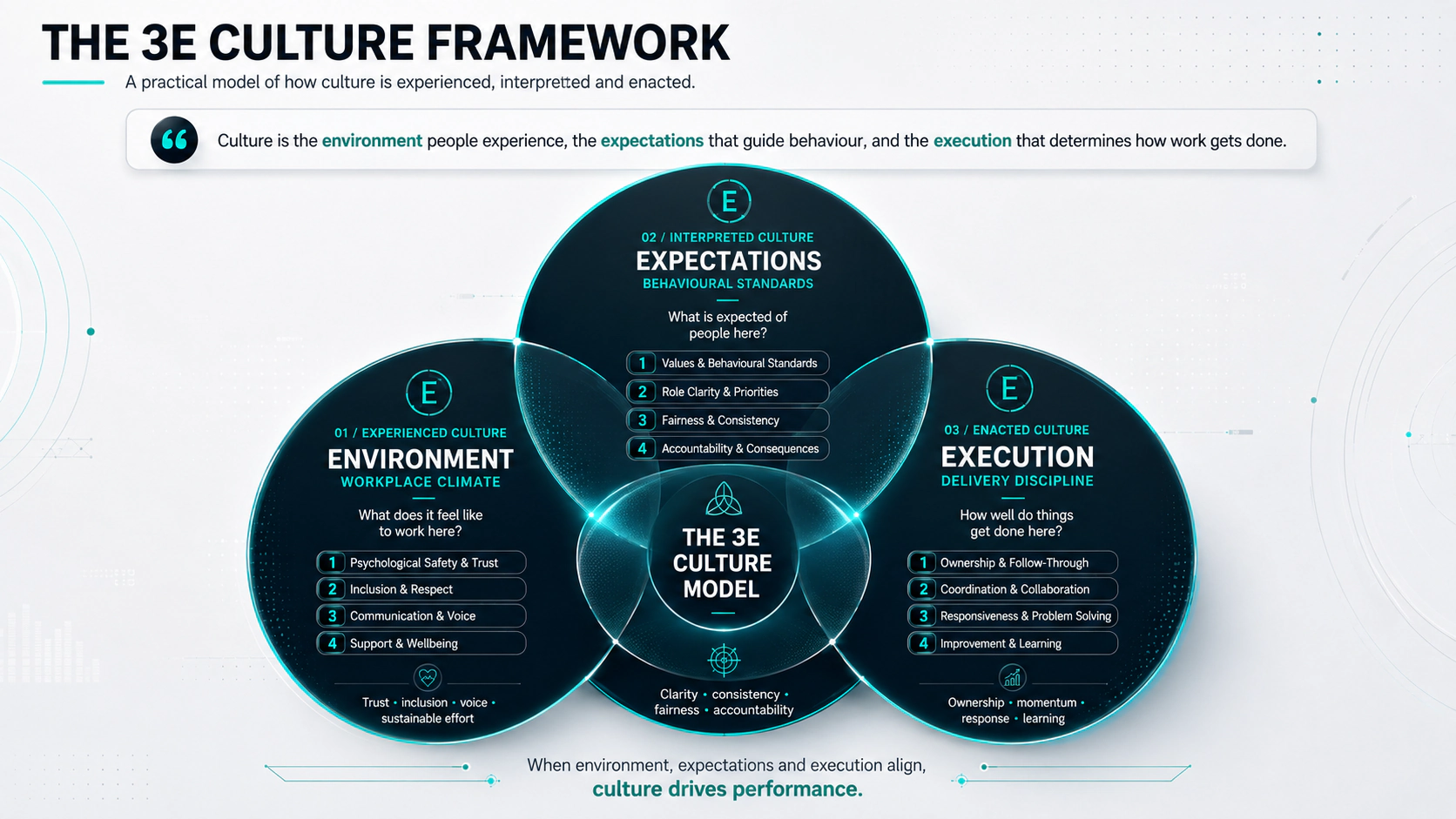
Experienced culture
Environment
The climate people experience—especially when pressure is high, mistakes occur or difficult issues need to be raised.
- Psychological Safety & Trust
- Inclusion & Respect
- Communication & Voice
- Support & Wellbeing
Leadership priorityCreate the conditions for honest contribution through consistent tone, respectful decisions, visible listening, early support and calm responses.
Interpreted culture
Expectations
The values, priorities, standards and behavioural boundaries that translate broad aspirations into practical choices.
- Values & Behavioural Standards
- Role Clarity & Priorities
- Fairness & Consistency
- Accountability & Consequences
Leadership priorityMake expectations usable through clear priorities, decision principles, role modelling, feedback, recognition and fair accountability.
Enacted culture
Execution
The discipline that converts decisions and commitments into action without constant chasing, avoidable rework or individual heroics.
- Ownership & Follow-Through
- Coordination & Collaboration
- Responsiveness & Problem Solving
- Improvement & Learning
Leadership priorityCreate disciplined momentum through clear ownership, fewer barriers, useful review rhythms, cross-functional coordination and visible learning.
From cultural opinion to actionable insight
A flexible diagnostic for different organisational needs.
The architecture stays consistent while depth is matched to the decision, population and stage of the cultural journey.
Full diagnostic
A comprehensive baseline for transformation, culture change or detailed organisation-wide diagnosis across all 12 dimensions.
Core diagnostic
Organisation-wide insight where completion time and response rate are critical, while retaining the full 12-dimension architecture.
Pulse diagnostic
Targeted follow-up after intervention, focused-priority monitoring or a regular review of selected cultural shifts.
Leadership maturity review
Executive, board or leadership-team dialogue against behavioural maturity descriptions and the culture leaders are creating.
Assessments supporting the cultural journey
Combine organisation-wide evidence with focused diagnostic lenses.
The 3E Culture Map is the organising framework. Supporting assessments deepen the view of employee experience, cultural alignment, team conditions and leadership impact without replacing contextual evidence.
Primary culture diagnostic
3E Culture Map
Choose a full, core or pulse diagnostic, or begin with a facilitated leadership maturity review. HR Delivery tailors language, segmentation, reporting and interpretation while protecting the integrity of the three pillars and 12 dimensions.
Discuss a 3E culture diagnostic3Eone connected cultural story
Experience · interpretation · action · accountability · progress
Employee Engagement Survey
Tracks commitment, advocacy, discretionary effort and the organisational conditions helping people perform, stay and contribute.
Supports: Environment · shared experience · follow-throughOpen Engagement SurveyFocused Employee Pulse Surveys
Checks selected priorities between full diagnostics and shows whether cultural action is becoming visible in everyday work.
Supports: Track · review · adjustOpen Pulse SurveysCultural Match Assessment
Supports evidence-led conversations about alignment with distinctive organisational values, standards and ways of working.
Supports: Expectations · onboarding · cultural dialogueOpen CMATeam Combination
TWI, TCP and TPW reveal workstyle diversity, contribution coverage and the conditions needed for collective performance.
Supports: Environment · coordination · accountabilityOpen Team CombinationLeadership Discovery
Leadership 360, emotional intelligence and shadow-risk evidence help leaders understand the cultural signals they send.
Supports: all three Es · leadership impact · pressure riskOpen Leadership DiscoveryTeam Performance WatchPoints
A focused view of trust, challenge, commitment, accountability and results for intact or cross-functional teams.
Supports: local culture · team dialogue · executionOpen TPWCulture maturity
A clear language for the next step.
Maturity describes how consistently culture is experienced, reinforced and supported by systems—not whether an organisation is simply good or bad.
Fragmented
Experience is inconsistent, reactive, locally variable and heavily manager-dependent.
Action: stabiliseEmerging
Positive intent and pockets of good practice exist but are not yet reliably reinforced.
Action: standardiseEstablished
Culture is generally reliable, visible and supported by leadership routines.
Action: strengthenEmbedded
Culture is self-reinforcing, system-supported and resilient under pressure.
Action: sustain and spreadHow the 3E Culture Map works
A diagnostic process designed to create visible follow-through.
Culture assessment creates value only when people see that insight leads to thoughtful action.
- 01
Define
Confirm purpose, sponsorship, decisions, reporting groups and success measures.
- 02
Listen
Tailor the diagnostic, explain confidentiality and gather employee or leadership input.
- 03
Map
Analyse three pillars, 12 dimensions, group differences, themes and maturity.
- 04
Interpret
Combine results with context, operational evidence, listening and leadership dialogue.
- 05
Act
Prioritise a few shifts with observable behaviours, routines, owners and measures.
- 06
Track
Close the feedback loop, review progress and use targeted pulse measures.
Responsible diagnosis. Practical culture change.
Designed to protect trust and support better decisions.
Results are reported at aggregate level. Small groups are suppressed or combined, open comments are reviewed to protect identity and comparisons are interpreted carefully in context.
The purpose is to understand systems and shared experience—not judge, discipline or identify individual employees. The 3E Culture Map is described as structured diagnosis and evidence-led action, not as a fully normed benchmark before sufficient pilot and validation evidence exists.
Is the 3E Culture Map an engagement survey?
It can complement engagement measurement, but goes further by examining workplace climate, experienced standards and the execution habits shaping how work gets done.
How long does the assessment take?
The core diagnostic contains 48 items and the full diagnostic 60. A shorter 12- to 24-item pulse can track selected priorities after action begins.
Can the framework be tailored?
Yes. Wording, examples, segmentation, reporting and leadership materials can be adapted while retaining the three pillars and 12 dimensions.
What happens after the assessment?
Leaders receive a structured profile, facilitated interpretation, priority themes and an action-planning process, followed by pulse measures and review conversations.