
HR Delivery 3S Individual Contributor Framework
Build contribution that lasts.
Define how people deliver quality work, contribute to others and manage themselves—then turn evidence into focused development.
Your HR Delivery directories
Explore our approach. Find your starting point.
Standards. Support. Self-Management.
Give every contributor a clear development language.
Individual contributors shape service quality, customer experience, operational reliability and organisational culture every day. Yet expectations are often implied rather than clearly described.
The 3S framework defines excellent contribution in observable terms. It creates a fair basis for self-reflection, manager review, coaching, performance conversations and practical 60- to 90-day development.
The complete model
Strong contribution requires all three pillars—in balance.
Task completion alone is not enough. Effective individual contribution combines the quality of work, contribution to others and personal responsibility, demonstrated consistently in real situations.
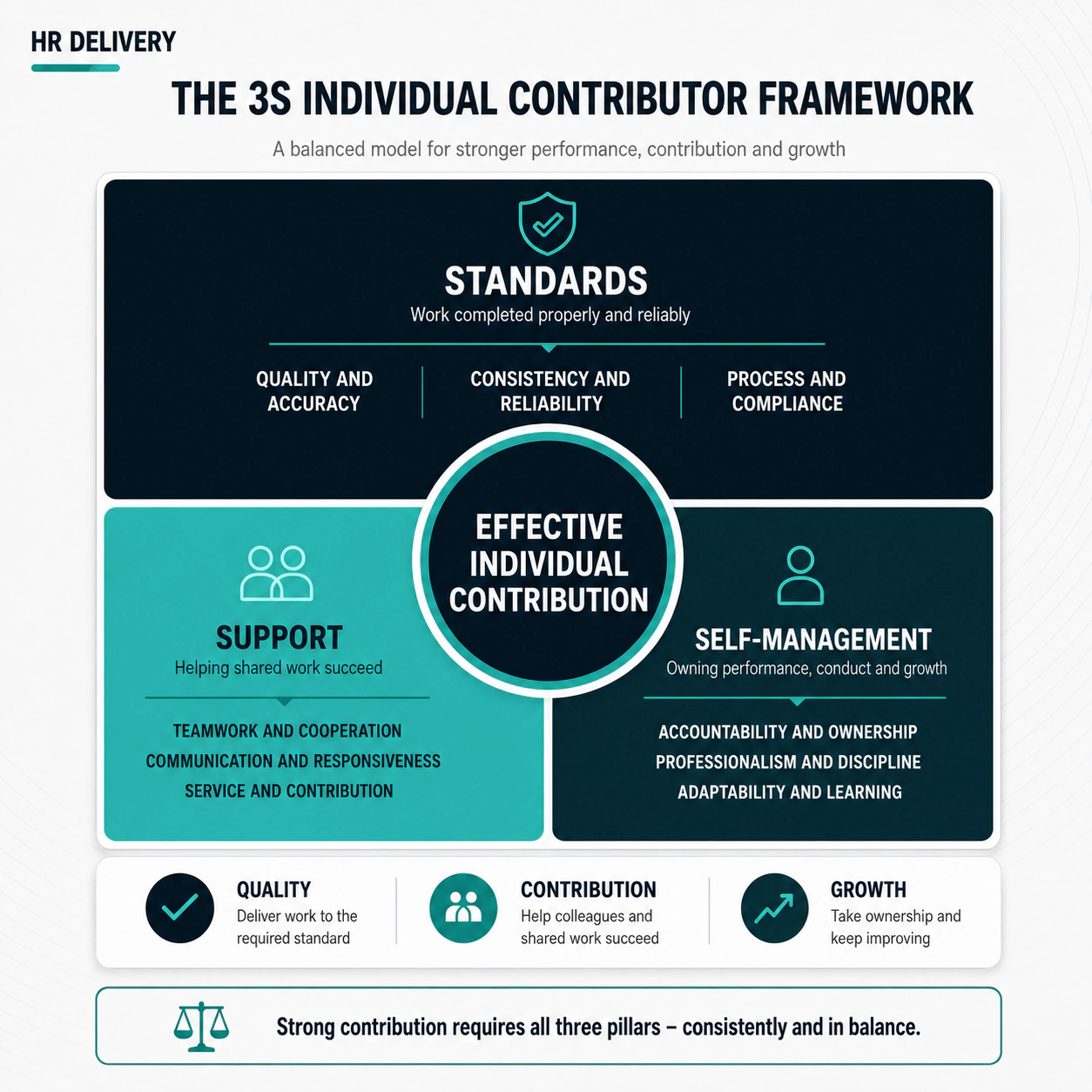
Quality of work
Standards
Protects quality, safety and trust through accuracy, dependable delivery and disciplined use of required processes.
Quality and Accuracy
Produces work carefully and to the required standard, with attention to detail and minimal errors.
- Checks work before completion.
- Maintains accuracy under pressure.
- Prevents avoidable rework.
Consistency and Reliability
Follows through dependably and maintains a steady standard over time.
- Completes agreed tasks on time.
- Provides timely progress updates.
- Works without repeated prompting.
Process and Compliance
Uses required procedures, controls and documentation so work is completed properly and safely.
- Applies agreed processes.
- Recognises when compliance matters.
- Reduces avoidable risk.
Contribution to others
Support
Recognises that individual performance affects colleagues, stakeholders and customers through cooperation, communication and practical support.
Teamwork and Cooperation
Works constructively with colleagues and contributes fairly to collective goals.
- Builds cooperative relationships.
- Shares responsibility appropriately.
- Assists shared delivery.
Communication and Responsiveness
Keeps others appropriately informed and responds clearly and promptly.
- Shares relevant information.
- Responds constructively.
- Signals risk or delay early.
Service and Contribution
Provides respectful, helpful and solutions-focused support to the wider service.
- Understands wider contribution.
- Supports stakeholders practically.
- Looks beyond narrow boundaries.
Personal responsibility
Self-Management
Creates sustained performance through ownership, professional discipline and the ability to learn and adapt without constant direction.
Accountability and Ownership
Owns work, commitments and issues rather than avoiding responsibility.
- Raises concerns early.
- Takes appropriate initiative.
- Escalates responsibly.
Professionalism and Discipline
Manages time, conduct and responsibilities reliably and professionally.
- Uses time well.
- Applies sound judgement.
- Represents the organisation well.
Adaptability and Learning
Responds positively to change and turns feedback and experience into improved performance.
- Adapts constructively.
- Uses feedback without defensiveness.
- Builds capability over time.
Maturity and career growth
Five stages of individual contribution.
Maturity reflects the consistency, independence, judgement and transferability of contribution shown in real work. It is not a proxy for tenure, grade or management potential.
Foundation Contributor
Learns the role and builds habitsCompletes defined tasks with guidance while building accuracy, reliability, professional habits and confidence.
Developing Contributor
Builds independence and consistencyCompletes routine work more independently and manages workload, updates and follow-through with growing consistency.
Capable Contributor
Delivers dependable contributionWorks reliably across quality, cooperation, communication, ownership and professional conduct with limited prompting.
Advanced Contributor
Handles complexity and improves practiceApplies strong judgement in complex work, supports others through example and improves local routines within role scope.
Expert Contributor
Shapes standards and practiceCoaches others, transfers knowledge and strengthens service resilience without relying on formal authority.
From observation to action
Use behaviour as evidence—not as a label.
Positive behaviours show what effective contribution looks like. Development signals identify patterns that may limit impact and help focus the conversation on improvement.
Positive evidence
- Accurate work and active error prevention.
- Reliable follow-through and timely updates.
- Constructive cooperation and practical support.
- Ownership, professional conduct and sound judgement.
- Learning applied to future performance.
Development signals
- Avoidable errors or inconsistent standards.
- Missed commitments or updates provided too late.
- Working in isolation when coordination is required.
- Defensiveness, blame or passive ownership.
- Feedback heard but not translated into change.
- 01
Collect evidence
Use recent examples from real work—not impressions or personality labels.
- 02
Identify the pattern
Match the highest level shown consistently across the relevant competency and context.
- 03
Choose the priority
Recognise strengths, then focus on the one or two behaviours that would make the greatest difference.
- 04
Act and review
Agree one to three practical actions for the next 60 to 90 days, with support and a review point.
Assessments supporting individual development
Combine personal insight with real workplace evidence.
The recommended core pathway explores how someone learns, works, what drives them and how their behaviour may be experienced. Results guide development; they do not replace evidence of work quality, conduct or contribution.
Recommended core pathway · AC01
Personal Development Combination
Four complementary assessment lenses create one coherent development story and a focused 30-60-90 day plan without reducing the person to a single type or score.
Open the Personal Development pathway4complementary assessment lenses
Learning preference, workstyle, motivation, pressure response and behavioural range.
Learning Preference Questionnaire
Identifies preferred and stretch learning routes so development is more likely to transfer into daily work.
Supports: Self-Management · Adaptability and LearningOpen LPQWork Styles Indicator
Explores communication, decisions, conflict, stress and personal-impact preferences relevant to Support and Self-Management.
Supports: Support · Communication · ResponsivenessOpen WSIPersonality Pattern Profile
Explores recurring motivations, pressure responses and growth directions that may influence ownership and contribution.
Supports: Self-Management · Professionalism · GrowthOpen PPPPersonal Insights Profile
Builds an accessible view of personal energy, communication, decision style and behavioural range.
Supports: Support · Contribution · AdaptabilityOpen PIPTargeted assessment extensions
From framework to everyday practice
Discover, design, assess, develop and embed.
HR Delivery adapts the 3S framework to the organisation's roles, culture and strategy, then connects it to real people processes.
Discover
Review strategy, role families, critical work, existing frameworks and current talent processes.
Design
Adapt the competencies, behavioural indicators and maturity anchors to the organisation.
Assess
Combine proportionate assessment tools with self-reflection, manager review, interviews and workplace evidence.
Develop and embed
Connect results to coaching, learning, IDPs, career pathways, performance and talent decisions.