

HR Delivery OD Diagnostic Model
See the organisation clearly. Act where it matters.
A structured, evidence-led view of the organisational conditions shaping performance, engagement and sustainable delivery.
Your HR Delivery directories
Explore our approach. Find your starting point.
What is the OD Diagnostic Model?
Understand the organisation as one connected system.
Organisations rarely struggle because of one isolated problem. Strategy, leadership, structure, culture, people practices and systems interact. A weakness in one area can create symptoms elsewhere - slow decisions, low confidence, duplicated effort, poor execution or change fatigue.
The HR Delivery OD Diagnostic Model creates a shared view of that system. A structured survey, supported where useful by interviews, workshops or facilitated discussion, turns employee and stakeholder experience into focused improvement priorities with named owners and review points.
The complete model
Eight dimensions. One organisational system.
The model provides a practical language for understanding how the organisation works and where targeted action can have the greatest effect.
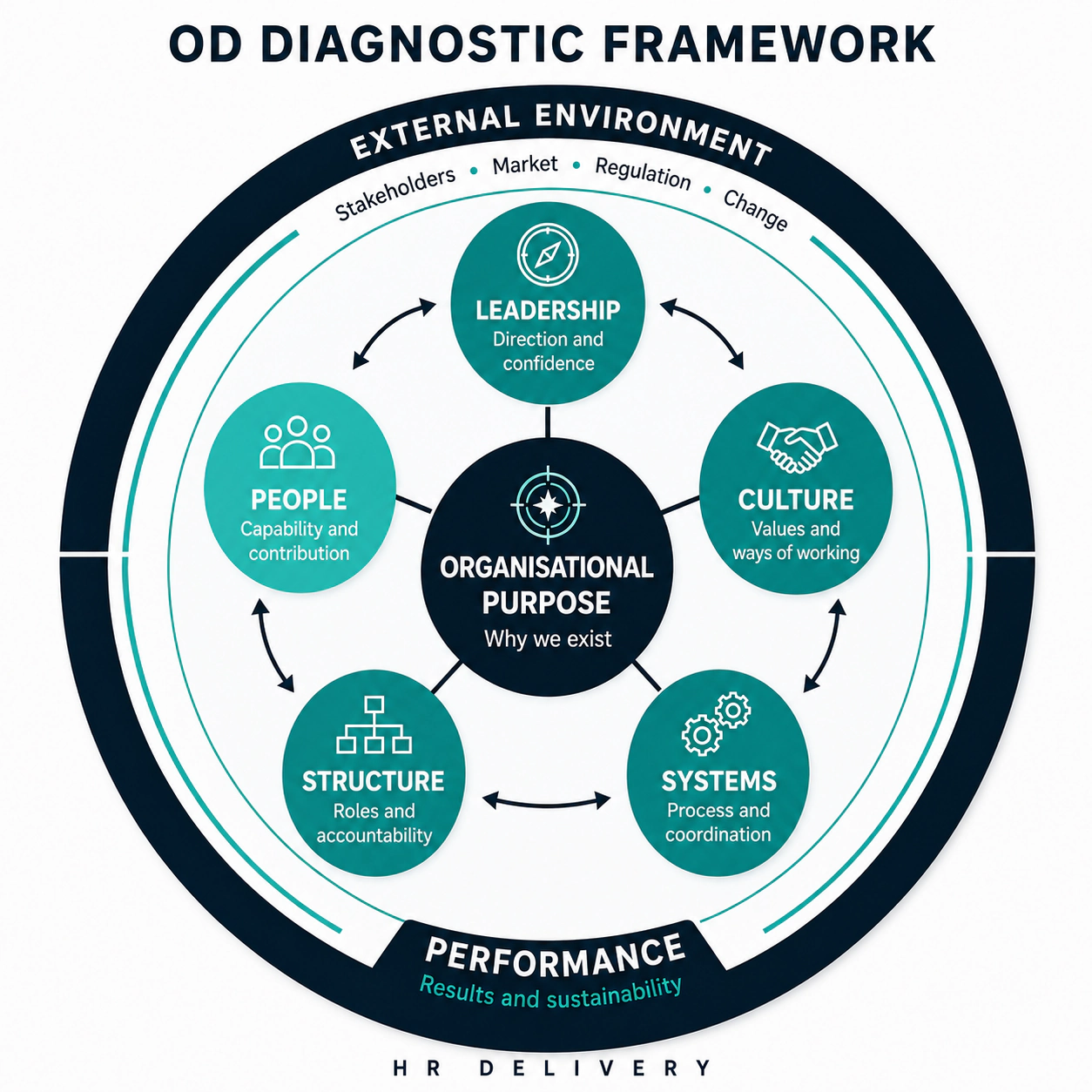
External Environment
Focus: Stakeholders, partnerships, responsiveness, reputation and future opportunity.
Diagnostic lens: How well does the organisation understand change outside its boundaries and respond to stakeholder needs?
Organisational Purpose
Focus: Mission, strategy, priorities, resources, objectives and line of sight.
Diagnostic lens: Do people understand the direction, what is expected and how their work contributes?
Leadership
Focus: Direction, alignment, trust, empowerment, role modelling, change and employee experience.
Diagnostic lens: Do leaders create clarity, listen, unite people and take responsibility for performance and change?
People
Focus: Morale, motivation, capability, workload, development, talent, succession and information.
Diagnostic lens: Does the organisation create the conditions in which people can perform, grow and sustain wellbeing?
Culture
Focus: Values in practice, fairness, safety, voice, learning, support and continuous improvement.
Diagnostic lens: Do everyday behaviours match stated values, and can people raise concerns, learn and improve?
Structure
Focus: Accountabilities, communication, decision involvement, authority, workflow and workload distribution.
Diagnostic lens: Does the structure support clear ownership, effective decisions and cross-functional delivery?
Systems
Focus: Policies, information, reward, development, performance management, management information and technology.
Diagnostic lens: Do formal and informal systems help people work, develop and make informed decisions?
Performance
Focus: Quality, standards, indicators, benchmarking, improvement, accountability and recognition.
Diagnostic lens: Does the organisation sustain high standards, learn from evidence and recognise contribution?
The client journey
From insight to action in six managed stages
The diagnostic works as an organisational development process: prepare well, listen carefully, interpret patterns, agree a focused response and review whether action improves the environment.
- 01
Confirm scope
Agree the organisational area, the decision the evidence must support and the outcomes that matter.
- 02
Prepare the launch
Define timing, communications, response groups, confidentiality safeguards and reporting segments.
- 03
Listen
Collect survey responses and comments, supported by interviews, focus groups or facilitated workshops where useful.
- 04
Analyse
Review item results, dimension profiles, positive agreement, group variation and recurring written themes.
- 05
Make sense
Facilitate evidence-led discussion to understand root causes, connections and the story behind the pattern.
- 06
Act and review
Select high-value priorities, assign owners and milestones, implement changes and re-measure when useful.
Evidence and outputs
A balanced view leaders can act on
Numerical patterns show where to look. Written comments and facilitated discussion explain why the pattern may exist. HR Delivery combines all three so action is grounded in evidence rather than averages alone.
Quantitative profile
Dimension averages, item-level results and positive agreement reveal the strongest and weakest patterns.
Qualitative evidence
Comment themes, examples and recurring concerns add meaning and expose local realities.
Sense-making
Facilitated discussion tests interpretations, connects dimensions and prevents premature conclusions.
Action priorities
A priority matrix and action plan translate evidence into focused action, ownership and review.
What clients receive
Application
One framework, multiple organisational questions
The diagnostic can be deployed across an entire organisation or focused on the part of the system where leaders need clearer evidence.
Whole-organisation health check
Understand the conditions supporting organisational performance, engagement and long-term sustainability.
Culture and engagement insight
Identify where voice, fairness, values, learning, trust and support are strong or under pressure.
Function, site or team review
Compare experiences across areas where response numbers allow meaningful and confidential analysis.
Change readiness
Assess whether alignment, leadership, capability, systems and culture are ready for transformation.
Strategy implementation
Test whether purpose, priorities, resources and objectives are clear to the people responsible for delivery.
Post-change learning
Review whether agreed actions have improved the working environment and strengthened delivery.
Frequently asked questions
What organisations need to know
Is this an employee engagement survey?
It can provide engagement and culture insight, but it is broader. It examines purpose, leadership, people, culture, structure, systems, performance and the external environment as one connected system.
Can the diagnostic be tailored?
Yes. The eight-dimension architecture and positive-statement method remain consistent, while terminology, reporting labels, segmentation and selected contextual items can be adapted.
How is the diagnostic completed?
It can be delivered as an online survey, paper questionnaire, structured interview, facilitated group discussion or mixed-method process.
How are results interpreted?
Reporting can combine averages, positive agreement, item and dimension patterns, group variation and comment themes, strengthened by facilitated discussion.
Can teams or locations be compared?
Yes, where data are sufficient for meaningful and confidential analysis without identifying individuals.
What happens after the report?
HR Delivery helps people understand the story behind the results, identify root causes, agree manageable priorities and establish owners and review points.