

Organisational Engagement Framework
Turn employee feedback into focused organisational action.
Measure engagement, diagnose the organisational conditions shaping the employee experience and convert insight into clear organisational, departmental and team-level action plans.
Your HR Delivery directories
Explore our approach. Find your starting point.
Beyond a single survey score
Understand how people feel—and what is shaping that experience.
An overall engagement percentage cannot explain why employees feel the way they do or what leaders should change. HR Delivery separates the outcome from the organisational conditions influencing it, then shows where experiences differ.
The result is a practical listening and improvement system: evidence for senior leaders, useful insight for managers and visible follow-through for employees.
Three different questions
Outcomes, drivers and future intentions are related—not interchangeable.
Engagement outcomes
How employees currently feel about the organisation and their work: pride, advocacy, commitment, motivation, discretionary effort and accomplishment.
What is the current relationship?Organisational drivers
The leadership, management, cultural and workplace conditions that strengthen or weaken engagement across five connected domains.
What is influencing it?Retention and future intentions
Whether employees expect to remain, see a future in the organisation and believe it can sustain a positive employment experience.
What may happen next?The Engagement Heat Map Model
Fifteen themes reveal the complete employee experience.
The Employee Engagement Index is reported separately from 13 organisational drivers and Retention and Future Intentions. This prevents one headline score from hiding local strengths, barriers or emerging risk.
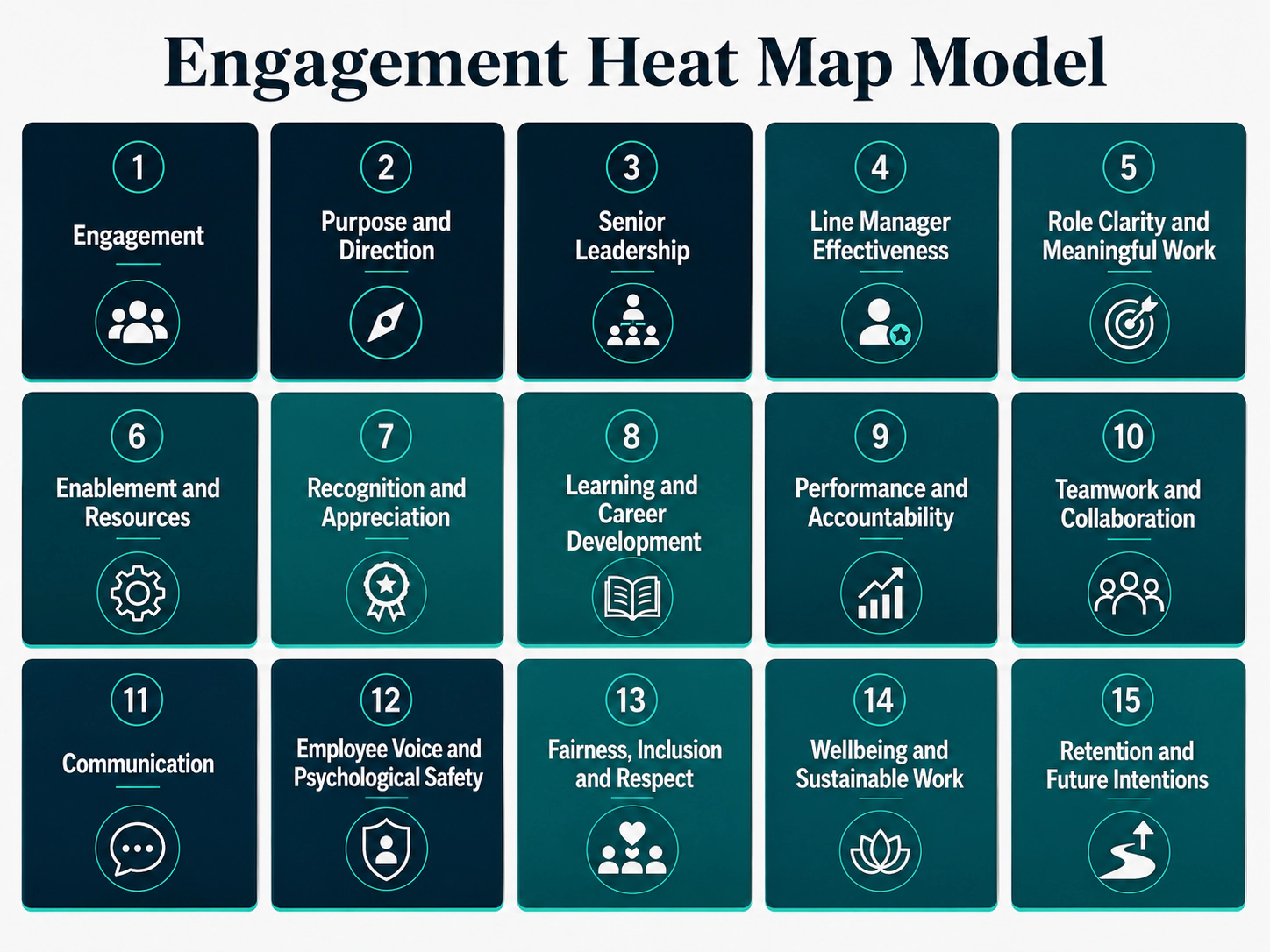
Connected
Employees understand the organisation and feel part of it.
- Purpose and Direction
- Senior Leadership
- Communication
- Teamwork and Collaboration
Enabled
People have the clarity, resources and conditions needed to perform.
- Role Clarity and Meaningful Work
- Enablement and Resources
- Performance and Accountability
Supported
Employees feel recognised, cared for and sustainably supported.
- Line Manager Effectiveness
- Recognition and Appreciation
- Wellbeing and Sustainable Work
Empowered
People feel respected, included and able to influence their workplace.
- Employee Voice and Psychological Safety
- Fairness, Inclusion and Respect
Developed
Employees believe they can learn, grow and build a future here.
- Learning and Career Development
Full and pulse options
Match the depth of listening to the decision.
Both options use clear constructs, behaviourally specific statements, consistent response scales and confidential reporting thresholds.
Full Organisational Engagement Assessment
A comprehensive baseline for annual listening, transformation, culture review, restructuring, workforce integration or strategic employee-experience improvement.
- Five to eight Engagement Index statements
- Multiple items for every principal theme
- Two or three open-text questions
- Demographics and optional client modules
Engagement Pulse Survey
A focused follow-up for selected priorities, change periods and action-plan monitoring. Pulse surveys support—not replace—a deeper organisational diagnosis.
- Track priority themes
- Test whether actions are visible
- Monitor sentiment during change
- Provide more frequent leadership feedback
Optional specialist modulesCulture and ValuesChange and AgilityInnovationCustomer FocusReward and BenefitsTrust and Integrity
Decision-ready reporting
See the organisational story—and where experiences differ.
Subject to confidentiality thresholds, results can be analysed across business units, functions, departments, teams, locations, grades, job families, management levels and workforce groups.
Executive report
Engagement Index, organisation-wide themes, strengths, concerns, retention indicators, key drivers and strategic recommendations.
Diagnostic report
Theme and item results, response distributions, group comparisons, open-text insight and priorities for action.
Function and team reports
Focused local evidence showing relative strengths, important differences and actions within leaders’ direct control.
Heat maps
An immediate view of strong areas, inconsistent experiences, targeted improvement needs and elevated engagement or retention risk.
Open-text analysis
Recurring concerns, positive experiences, emerging risks, employee suggestions and issues needing deeper investigation.
Trend and pulse reports
Movement in engagement, progress against priorities, emerging concerns and the visible impact of interventions.
Engagement Priority Matrix
Focus on impact—not simply the lowest score.
Priorities consider current performance, relationship with engagement, employees affected, influenceability and strategic importance.
ProtectImportant strengths to maintainPrioritiseHigh-impact issues needing actionImproveMaterial areas with moderate impactMonitorStable themes to keep under review
From insight to action
A six-stage cycle that closes the feedback loop.
Each selected action has an objective, accountable owner, activities, timeline, resources, success measures and review date.
- 01
Measure
Define the listening purpose, workforce, confidentiality rules and success measures.
- 02
Diagnose
Read outcomes, drivers, comments and group differences together.
- 03
Prioritise
Select issues with material impact, reach, risk and strategic importance.
- 04
Act
Address root causes through owned organisational, local and team actions.
- 05
Monitor
Track delivery, communicate progress and use targeted employee feedback.
- 06
Improve
Review impact, adapt interventions and repeat focused measurement.
Supporting assessments
Deepen the diagnosis without confusing different evidence.
The engagement framework organises workforce listening. Supporting tools add focused evidence about culture, teams, leadership, wellbeing and day-to-day management.
Employee Engagement Survey
Full organisation-wide measurement of engagement, drivers and future intentions.
Employee Pulse Survey
Focused tracking of selected priorities between comprehensive assessments.
Culture Map Assessment
Connects employee experience with Environment, Expectations and Execution.
Team Performance Watchpoints
Reveals trust, challenge, commitment, accountability and collective results.
Leadership Discovery and 360
Shows how leadership behaviour and impact may shape workforce experience.
Workplace Wellbeing
Deepens analysis of sustainable work, support, pressure and recovery.
Management diagnostics
Explores the productivity, people and performance practices affecting teams.
Team diagnostics
Combines workstyles, contribution and watchpoints to explain local patterns.
Confidential by design
Protect trust before collecting a response.
Minimum group-reporting thresholds, small-group suppression and careful open-text review protect anonymity. Access, retention, demographic segmentation and escalation rules are agreed before launch.
Reports support constructive organisational improvement. They are not designed to identify individual respondents or create simplistic rankings of managers.
How is engagement different from satisfaction?
Satisfaction considers contentment with employment conditions. Engagement also considers pride, commitment, advocacy, motivation and willingness to contribute additional effort.
Is the assessment confidential?
Yes. Reporting thresholds and suppression rules prevent results being shown for groups too small to protect anonymity.
Can the questionnaire be tailored?
Yes. Language, demographics and optional modules can reflect the organisation while the underlying measurement structure remains consistent.
What reports are available?
Executive, diagnostic, business-unit, function, department and team reports can be supported by heat maps, open-text analysis, action plans and trend reporting.
Does the process include action planning?
Yes. The framework links priorities to root causes, ownership, measurable actions, communication and progress monitoring.
Can it be used during organisational change?
Yes. A Change and Agility module can examine confidence, communication, involvement and readiness during transformation.