
Organisational Wellbeing Framework
Build healthier people, healthier work and sustainable performance.
A whole-system approach connecting work design, employee experience, leadership, organisational practice and responsible evidence—not a collection of isolated wellness activities.
Your HR Delivery directories
Explore our approach. Find your starting point.
Move beyond wellbeing activity
Design wellbeing into the way work works.
Wellbeing is shaped every day by workload, clarity, leadership, relationships, fairness, safety, flexibility, technology, opportunity and the support available when people experience difficulty.
The framework creates a shared language, a structured organisational assessment and a disciplined route from evidence to practical improvement. It emphasises prevention and healthy work design while retaining timely, appropriate support.
The organisational challenge
Healthy performance cannot be built on fragmented activity.
Campaigns and benefits can help, but they cannot compensate for persistent overload, unclear expectations, unsafe work, weak management or an environment where concerns cannot be raised.
Fragmented activity
Initiatives exist without a common framework, clear ownership or an organisational strategy.
Limited evidence
Leaders cannot see which conditions or workforce groups require attention first.
Individualised responsibility
Employees are asked to become more resilient while sources of strain remain unchanged.
Weak follow-through
Results are communicated, but actions, owners, measures and review are not sustained.
The complete model
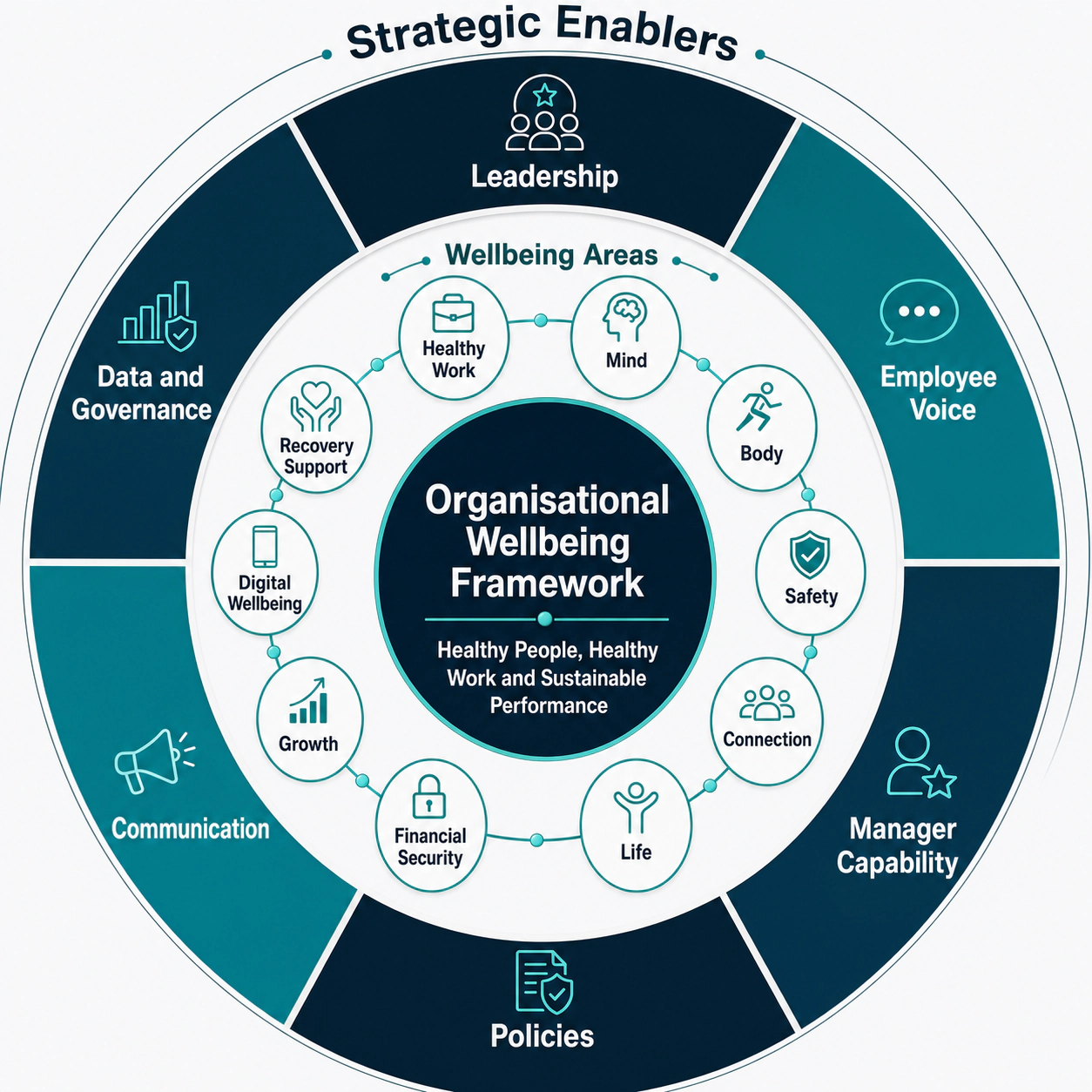
One outcome. Ten wellbeing areas. Six strategic enablers.
The centre defines the objective. The inner ring shows the employee and work experiences shaping wellbeing. The outer ring shows the organisational capability needed to improve and sustain it.
Healthy Work
Sustainable workload, role clarity, autonomy, resources, working time and realistic expectations.
Mind
Psychological wellbeing, psychological safety, stress prevention and early access to help.
Body
Energy, physical health, ergonomics, mobility, fatigue and support for ongoing health needs.
Safety
Healthy environments, safe systems, occupational risk prevention and appropriate response.
Connection
Trust, inclusion, dignity, belonging and respectful relationships across the organisation.
Life
Work-life integration, boundaries, leave, flexibility, caregiving and meaningful recovery time.
Financial Security
Fairness, transparency, benefits awareness and responsible support for financial strain.
Growth
Purpose, recognition, strengths, learning, employability and a credible future at work.
Digital Wellbeing
Usable technology, focused work, healthy communication boundaries and responsible monitoring.
Recovery Support
Confidential support, adjustment, rehabilitation, professional referral and sustainable return to work.
Six strategic enablersLeadershipEmployee VoiceManager CapabilityPoliciesCommunicationData and Governance
Organisational Wellbeing Assessment
Confidential insight into employee experience, working conditions and organisational capability.
A configurable assessment combines employee experience with organisational evidence. It identifies strengths, concentrated pressures and the conditions most strongly associated with sustainable wellbeing.
Employee evidence
- Confidential questionnaire across the ten areas
- Optional open-text insight and suggestions
- Meaningful demographic analysis with minimum group thresholds
- Targeted focus groups and listening
Organisational evidence
- Absence, turnover, overtime, leave and safety indicators
- Leadership and manager interviews
- Policy, process and support-pathway review
- Operational context and workforce risk
Responsible purpose
- Organisational insight—not individual clinical diagnosis
- Aggregate reporting and agreed suppression rules
- Clear governance for sensitive data
- Evidence linked directly to communication and action
Reports and heat maps
Turn wellbeing evidence into clear decisions.
Decision-ready reporting shows the organisational picture while revealing meaningful differences across functions, locations and workforce groups where confidentiality thresholds are met.
Executive Wellbeing Report
Overall position, material risks, strengths, priority populations and strategic recommendations.
Organisational Heat Map
Ten wellbeing areas and six enablers compared across appropriate organisational groups.
Business-unit insight
Practical evidence for local leaders without exposing individual employee responses.
Priority Action Plan
Agreed owners, milestones, resources, measures, review dates and employee communication.
Three levels of intervention
Prevent harm, build capability and support recovery.
A credible strategy does not place every issue at the individual level. It starts with the conditions of work and adds timely support where needed.
Improve the work
Redesign workload, staffing, roles, systems, management routines, inclusion, safety and working boundaries to reduce avoidable risk.
Build capability
Equip employees and managers with practical skills, early-warning awareness, healthy routines and confidence to act.
Support and recover
Provide confidential assistance, occupational-health routes, adjustments, rehabilitation and sustainable return-to-work support.
How the framework is applied
From alignment to sustained improvement.
- 01
Align
Confirm context, governance, scope, populations and outcomes.
- 02
Diagnose
Gather assessment, workforce, policy and qualitative evidence.
- 03
Prioritise
Identify strengths, concentrated risks and key drivers.
- 04
Act
Build organisation-wide, local and targeted interventions.
- 05
Measure
Track delivery and test whether conditions are improving.
- 06
Sustain
Communicate progress, adapt and repeat focused measurement.
Assessments supporting the wellbeing journey
Connect organisational listening with focused diagnostic evidence.
The Organisational Wellbeing Assessment is the primary framework assessment. Supporting tools deepen the view of engagement, culture, teams, leadership, management and psychological safety.
Organisational Wellbeing Assessment
Configurable whole-system evidence across the ten wellbeing areas and six enablers.
Open Staff Wellbeing & Support SurveyEmployee Engagement Survey
Connects wellbeing with commitment, enablement and organisational experience.
Open Employee Engagement SurveyFocused Employee Pulse Surveys
Tracks selected priorities and the visibility of action between full assessments.
Open Focused Employee Pulse Surveys3E Culture Map
Explores the environment, expectations and execution shaping sustainable work.
Explore the 3E Culture MapTeam Performance WatchPoints
Reveals trust, challenge, commitment, accountability and collective results.
Open Team Performance WatchPointsLeadership Discovery
LEAD360, emotional intelligence and shadow-risk evidence illuminate leadership impact.
Open Leadership DiscoveryManagement diagnostics
Evidence about manager judgement, assumptions, execution and everyday people practice.
Explore management assessmentsTeam diagnostics
Workstyles, contribution and performance watchpoints explain important local patterns.
Explore Team DevelopmentGovernance and confidentiality
Responsible organisational insight—not clinical diagnosis.
Employee responses are treated confidentially and reported at group level. Small groups are suppressed or combined, sensitive comments are reviewed to protect identity and access is controlled.
The framework identifies organisational patterns and priorities. It does not diagnose individual physical or mental-health conditions, replace qualified clinical assessment or promise that one intervention will remove every source of risk.
Is this a wellness programme?
No. It is an organisational framework for diagnosing and improving work, employee experience, strategic capability and support.
Is the assessment clinical?
No. It provides aggregate organisational insight and does not diagnose individual health conditions.
Can the framework be tailored?
Yes. Scope, language, optional modules, segmentation and reporting can be adapted while retaining the whole-system architecture.
How is confidentiality protected?
Results are aggregated, minimum reporting thresholds are agreed and small groups are suppressed or combined.
What happens after the assessment?
Leaders receive reports and facilitated interpretation, then build prioritised actions with owners, measures and review dates.
Can we begin with one business area?
Yes. The framework can support an organisation-wide programme or a focused diagnostic for a unit, location, group or period of change.