

← Learning & Development Department
7A / PRACTITIONER SPACE
Training Needs Analysis
Start with the work. Invest in the right capability.
Follow the seven decisions of 7A: connect strategy and future work to evidence, priorities, development and measurable workplace application.

READ THE METHOD. USE THE RECORDS.
Your practitioner library
Original guides and reusable records, connected to the decisions below.
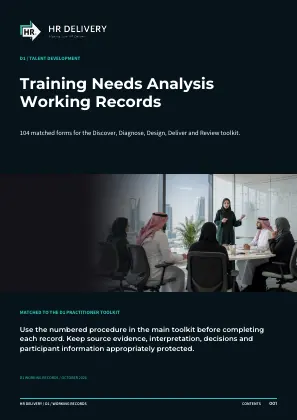
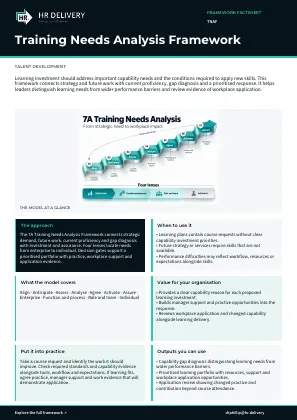
7A / THE PROCESS AT A GLANCE
7 connected decisions
Choose a step. Read the guidance, gather its inputs and use the matched records before moving on.
Return to earlier decisions when new evidence changes the assumptions. The toolkit’s Discover, Diagnose, Design, Deliver and Review sections organise its records; the 7A decisions control this process.
STEP 01 / 07
Align
What to do
Confirm the strategic outcome, performance question, sponsor and scope before considering a course. Agree the evidence standard, owners and decision rights.
Bring these inputs
- Approved strategy or service priority and the critical work contributing to it.
- Defined outcome measure, checked baseline and sponsor mandate.
- Scoped population, decision rights and authorised evidence access.
Working documents for this step
D1-D03
Agree sponsor success criteria
Open working record · page 6 ↗Read the matching procedure · page 14 ↗D1-D06
Trace strategy to critical work
Open working record · page 9 ↗Read the matching procedure · page 20 ↗Use the working records for this decision. Sponsor judgement and approval stay with the organisation.
STEP 02 / 07
Anticipate
What to do
Examine credible changes in technology, customers, regulation and operating choices. Identify future tasks and capabilities while distinguishing committed changes from scenarios.
Bring these inputs
- Approved service/change plans, milestones and accountable owners.
- Task-owner walk-throughs and credible scenarios with differing work demands.
- Assumptions, confidence and signposts that would trigger a forecast review.
Working documents for this step
D1-G01
Forecast the work before the skills
Open working record · page 25 ↗Read the matching procedure · page 51 ↗D1-G02
Build the future-task scenario
Open working record · page 26 ↗Read the matching procedure · page 53 ↗Use the working records for this decision. Sponsor judgement and approval stay with the organisation.
STEP 03 / 07
Assess
What to do
Define observable proficiency, calibrate reviewers and examine current capability using proportionate, fair work evidence. Combine observation and work samples with employee and manager accounts.
Bring these inputs
- Approved task standards and acceptable/borderline work examples.
- Calibrated reviewer decisions and an authorised, representative sample.
- Current work products, observation notes, conditions and participant explanations.
Working documents for this step
D1-G04
Calibrate the required standard
Open working record · page 28 ↗Read the matching procedure · page 57 ↗D1-G06
Observe the work in context
Open working record · page 30 ↗Read the matching procedure · page 61 ↗Use the online tool for this part
- Select an approved section, family, grade and exact job-description ID.
- Create one assessment per employee ID/review cycle with employee, team and department.
- Rate every approved requirement 1–5, enter evidence, and save/resume drafts.
- View four equally weighted section scores and completeness; qualifications and experience share one section.
Keep these practitioner decisions explicit
- Approve local standards, calibrate reviewers and gather work evidence outside the scoring form.
- TNA source requirements cannot be replaced by client-submitted custom requirements; indicative qualification/experience benchmarks remain indicative.
STEP 04 / 07
Analyse
What to do
Locate the gap, affected population and confidence, then test rival causes. Separate capability needs from unclear expectations, workflow, tools, resources or other conditions.
Bring these inputs
- Required standards, current-state profile and evidence coverage.
- Ordinary, successful and contrary cases, process timing and tool/resource access.
- Practitioner accounts, cause tests and accepted owners for non-learning barriers.
Working documents for this step
D1-G16
Test competing root causes
Open working record · page 40 ↗Read the matching procedure · page 81 ↗D1-G19
Build the gap-and-cause register
Open working record · page 43 ↗Read the matching procedure · page 87 ↗Use the online tool for this part
- Calculate requirement/section development gaps from ratings and evidence.
- Review approved assessments by cycle/status using needs-by-group, frequent-needs and heatmap reports.
- Group reports by manager, team, department or family; export authorised CSV.
Keep these practitioner decisions explicit
- Test root causes and formulate organisational need statements in the working records.
- A higher native TNA percentage means more development need, not causal diagnosis, performance or successor readiness.
STEP 05 / 07
Agree
What to do
Compare value, risk, urgency, future relevance and feasibility. Keep mandatory requirements explicit and record funding, sequencing and accountable investment choices.
Bring these inputs
- Accepted need statements, prevalence, confidence and future criticality.
- Strategic priorities, mandatory obligations, dependencies and risk of delay.
- Full costs, capacity, baseline, benefit hypothesis and implementation constraints.
Working documents for this step
D1-S03
Build a transparent priority matrix
Open working record · page 49 ↗Read the matching procedure · page 98 ↗D1-S18
Write the investment case
Open working record · page 64 ↗Read the matching procedure · page 128 ↗Use the online tool for this part
- HR approves a submitted assessment or returns it with review notes.
- Use grouped needs and development-request reports as inputs to planning.
Keep these practitioner decisions explicit
- Make portfolio prioritisation, mandatory-learning, funding and capacity decisions through the approved human process.
- Approving an employee assessment does not approve investment, procurement or enrolment.
STEP 06 / 07
Activate
What to do
Choose responses that address diagnosed causes. Combine learning and coached practice with enabling changes, manager time, safe task opportunities and an owned implementation plan.
Bring these inputs
- Approved response/investment decisions, development brief and transfer conditions.
- Accessible resources, practice cases, facilitator capacity, manager time and participant communication.
- Real work allocation, observation, feedback and owners of non-learning changes.
Working documents for this step
D1-L11
Coach the first workplace attempt
Open working record · page 79 ↗Read the matching procedure · page 157 ↗Use the online tool for this part
- Record development actions with owner, date, success measure, progress and status.
- Add approved manual activities while retaining target-level evidence and technical adaptation notes.
- View workshop suggestions; gateway suggestions require an explicit different target map and rationale.
- Use existing Learning courses/programmes/practical activities separately within current permissions.
Keep these practitioner decisions explicit
- Arrange coaching, task opportunities, manager release, funding and workplace changes outside the TNA record.
- Suggestions do not automatically enrol learners, schedule reviews, send email or implement changes.
STEP 07 / 07
Assure
What to do
Compare capability, workplace application and business results against the baseline. Test conditions and other causes before deciding to scale, adapt, stop or refresh.
Bring these inputs
- Comparable baseline/follow-up work samples and calibrated task criteria.
- Evidence of opportunity, manager support, enabling changes and case complexity.
- Defined business measures, periods, denominators and change timelines.
Working documents for this step
D1-R04
Compare workplace application
Open working record · page 94 ↗Read the matching procedure · page 186 ↗D1-R13
Interpret the business measure
Open working record · page 103 ↗Read the matching procedure · page 204 ↗Use the online tool for this part
- View private individual assessment/development reports in the portal and as PDF.
- Retain action progress/status and review-cycle/status reports.
- Use Learning record/evaluation evidence separately when relevant and authorised.
Keep these practitioner decisions explicit
- Compare equivalent work over time and test contribution in the working records.
- Native TNA does not establish causation, calculate organisational ROI or prove impact when an action is marked completed.
DEEPEN THE PRACTICE
More support for the work
Use these alongside the process, with your own organisational evidence.
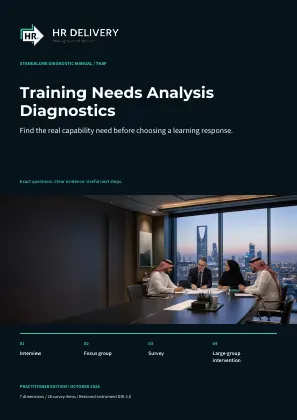

Bring the evidence into your workspace.
The existing Learning and Development tools support role evidence, individual plans and authorised reports. Strategic decisions, calibration and approvals remain with the accountable people. Organisation records require authorised access; private manager invitations retain their assigned scope.
Open Training Needs Analysis