B1 / Attraction, selection & retention

A promise that attracts.
An experience that proves it.

Build an employment offer that people understand, value and experience in practice. Connect employee evidence, a credible promise and accountable delivery through the Promise-to-Proof EVP System.

Your HR Delivery directories

Explore our approach. Find your starting point.

Download Assessment DirectoryDownload Framework DirectoryDownload Services Directory

B1 / Employer Value Proposition Toolkit

Make the employment deal worth choosing.

An employer value proposition expresses the employee value proposition: the employment deal people receive in return for their contribution. It includes meaningful work, choice, growth, relationships, reward and a sustainable working life. This collection helps you find what matters, check what is actually experienced and design a promise your organisation can deliver.

For HR and OD practitioners, talent and recruitment teams, operational leaders and consultants shaping an employment offer for the whole organisation or a defined workforce group.


Your working library

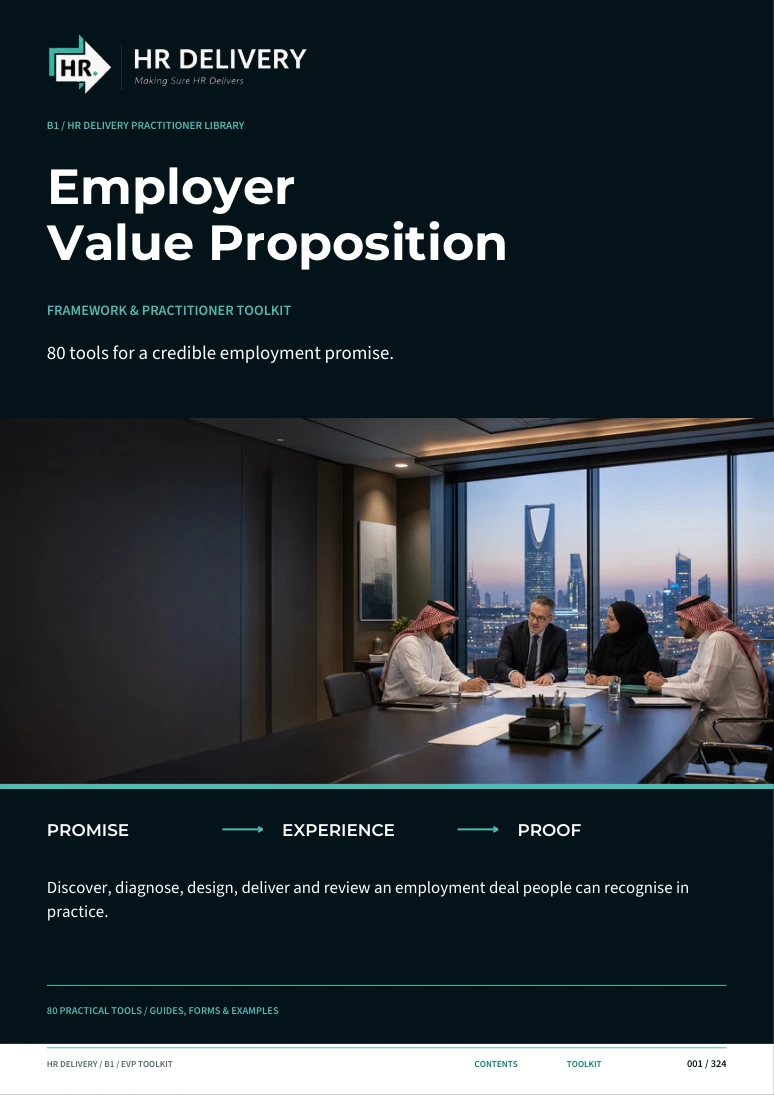
Employer Value Proposition Toolkit

Explore the complete toolkit, then use the supporting document alongside the guides and examples.

Complete practitioner toolkit

324pages
80practical tools

Eighty core practical tools take you from the initial mandate through listening, proposition design, activation and review. Each combines practitioner guidance, a working record and a completed fictional example. Twenty research practice extensions add focused checks on employee voice, proof, inclusion, testing and evaluation; the core tool definitions and instrument scoring remain unchanged.

Open the complete toolkit

97 pages / PDF

Working forms & templates

Browse the companion canvases and records for planning, evidence gathering, design choices, proof, implementation and review. Match the tool reference to its guide and example in the main toolkit.

View supporting document

92 pages / PDF

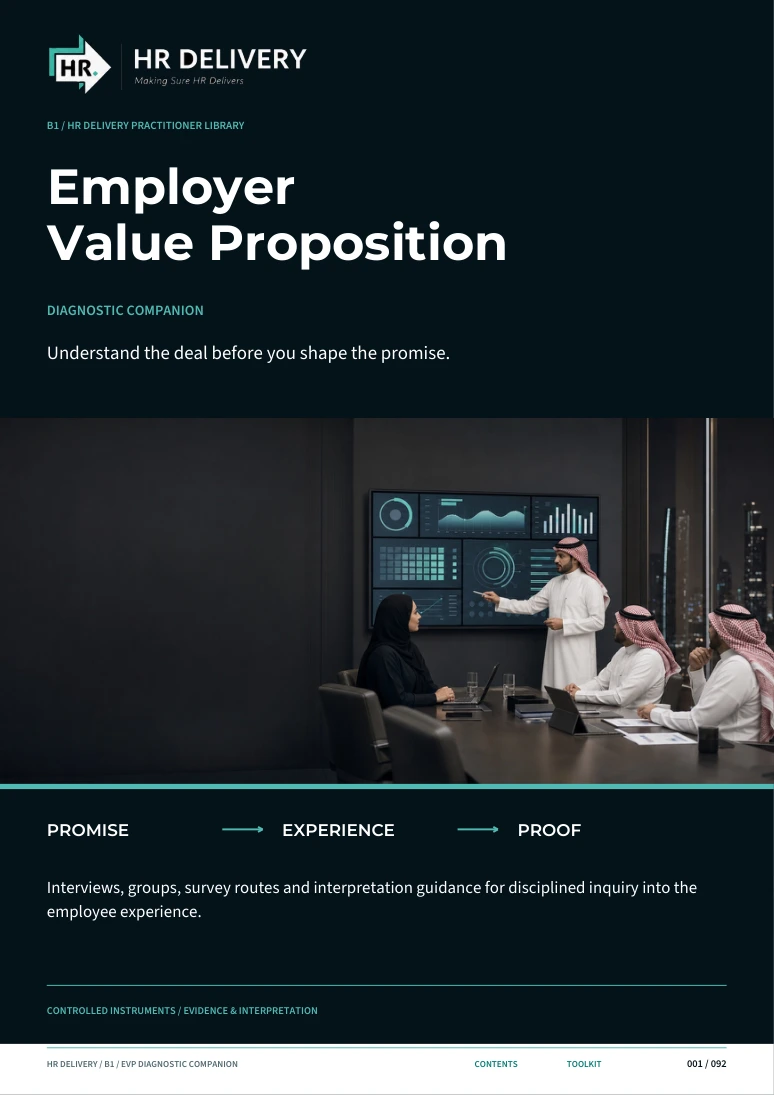
Employee Value Proposition Diagnostic Companion

A structured diagnostic resource for interviews, focus groups, surveys and large-group work. Use the controlled instrument wording, response rules and interpretation guidance when examining the employment deal.

View PDF

PDF resources are in English. Read on screen: Actual view on desktop and full width on mobile.

The thinking behind the tools

The Promise-to-Proof EVP System

The Promise-to-Proof EVP System connects strategic intent with an employment promise that can be substantiated. The original source groups twelve phases into four arcs, with a decision gate after each arc. MAGNET provides six lenses for examining the employment deal.

Four arcs. Twelve phases. Four decisions.

Use the gates to test whether the work is ready to progress. The source sequence is retained below.

  1. Align

    1. 01Mobilise and mandate
    2. 02Translate strategy into workforce requirements
    3. 03Prioritise talent audiences
    Decision gateStrategic licence
  2. Discover

    1. 04Diagnose the lived employee deal
    2. 05Read the external talent market
    3. 06Synthesise truths, gaps and choices
    Decision gateEvidence integrity
  3. Design

    1. 07Architect the core proposition
    2. 08Build segment propositions and proof
    3. 09Validate and stress-test
    Decision gatePromise authorisation
  4. Deliver

    1. 10Design activation and moments that matter
    2. 11Launch, equip and embed
    3. 12Measure, govern and renew
    Decision gateValue realisation
MAGNET is a coverage lens for evidence and questions. The six equal segments do not represent scores or a validated six-factor test.
  1. M

    Meaning

    Purpose, identity and a useful contribution.

  2. A

    Agency

    Voice, discretion, choice and the ability to do the work.

  3. G

    Growth

    Learning, skills, employability and realistic career opportunities.

  4. N

    Networks

    Leadership, manager support, relationships and belonging.

  5. E

    Earnings

    Reward, recognition, eligibility and security.

  6. T

    Thriving

    Sustainable work, recovery, wellbeing and trust.

Five practical stages for using the toolkit

These sections organise the eighty tools. They map to the source phases above and do not replace the EVP framework.

  1. 01

    Discover

    Earn the mandate, understand workforce priorities and agree the people, evidence and decisions in scope.

    16 tools · Phases 1–3
  2. 02

    Diagnose

    Listen to employees and candidates, examine the external market and identify the gaps between promise and experience.

    16 tools · Phases 4–6
  3. 03

    Design

    Choose a credible employment offer, build proof and test its value, access and practical delivery.

    16 tools · Phases 7–9
  4. 04

    Deliver

    Equip managers, connect recruitment and employee touchpoints, and make improvements owned and visible.

    16 tools · Phases 10–11
  5. 05

    Review

    Review experience, access and delivery evidence; renew, adapt or retire promises as circumstances change.

    16 tools · Phase 12

Keep promise, experience and proof together.

Give each claim evidence, eligibility conditions, an owner and a review date. Repair important experience gaps before making a wider public promise.

The original framework places phase 12 within Deliver; the concise website model labels it Measure. The toolkit uses Review for the same source phase. Keep the instrument versions separate: the DIR-2.0 companion has a 24-item survey, while the ebook contains a distinct 36-item research questionnaire. Their scoring keys are not interchangeable.

Explore the interactive framework

Read & diagnose

Build understanding.
Test the evidence.

Use the ebook to deepen your understanding, the diagnostic companion to examine experience and evidence, and the long read to challenge assumptions about the employment offer.

Ebook

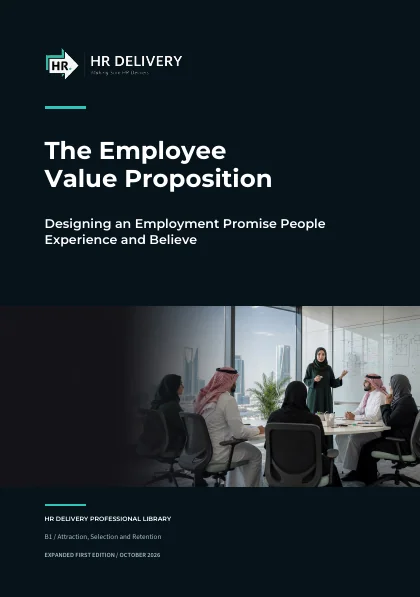
The Employee Value Proposition

Build an employment promise that people can recognise. Twelve chapters connect research, audience needs, proposition design, testing, delivery and renewal; the expanded companion adds twenty-nine framework applications, two fictional cases and fifteen practical resources.

View PDF

Diagnostic manual

Employee Value Proposition Diagnostic Companion

Use the controlled interview, focus-group, survey and large-group routes to examine the employment deal. Keep survey signals separate from evidence-based practice judgements and preserve the instrument version and response rules.

View PDF

Long-read article

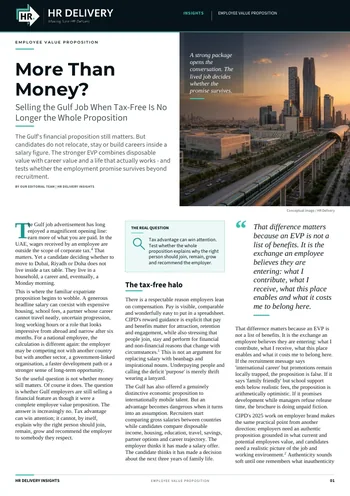
More Than Money?

Explore the employment bargain behind a Gulf recruitment offer: financial value, career opportunity and a workable life. Test whether the promise survives joining, progression and difficult moments; distinguish different audiences and local contexts.

View PDF

Related assessments

Support development.
Keep the evidence in context.

These assessments support individual career, strengths and capability conversations. They complement the development offer; they do not score an organisation’s EVP or replace employee listening and organisational evidence.

  1. Career Compass Assessment

    Explore interests, work environments and possible career directions in a voluntary development conversation. Use actual opportunities to test the Growth promise; results are not a competence measure or a promotion guarantee.

    Browse this assessment group
  2. Personal Strengths Navigator

    Help a colleague identify strengths they want to use in meaningful work. Individual relative preferences support development; do not average them into an EVP demand score or use them to allocate benefits.

    Browse this assessment group
  3. Behavioural Competency Assessment

    Identify manager development priorities relevant to listening, fair judgement and follow-through. Combine role-level results with observed work; individual scores do not measure organisation-wide EVP credibility.

    Browse this assessment group
  4. Technical Competency Assessment

    Explore role-specific technical development needs and connect them to accessible learning opportunities. Use the appropriate role, family and level with work evidence; a score does not prove every task or replace the development offer.

    Browse this assessment group

Learn & apply

Put knowledge
to work.

Explore a focused one-day introduction or build wider professional capability through a related development programme.

One-day workshop · In-house

An introduction to developing a credible employee value proposition

A one-day in-house introduction to Promise-to-Proof and the six MAGNET domains. Audit a promise, compare offered and experienced attributes, draft credible wording and connect it with delivery ownership. The agenda is agreed with the client.

01

Related development programme

HR Delivery HRBP – Human Resource Business Partners

Three days developing business understanding, workforce diagnosis, evidence-led advice and practical people plans. Supports the strategic choices and manager conversations needed to turn an EVP into accountable delivery.

Explore the programme
02

Related development programme

OD Practitioner Programme

Three days practising consultancy contracting, systems diagnosis, inclusive facilitation, intervention design and evaluation. Supports the employee listening and experience improvements that give an EVP its proof.

Explore the programme

A practical starting point

Choose your next step.

  1. 01

    Set the boundary

    Agree the business need, talent audience, sponsor and decision. Identify the evidence needed before choosing a promise.

  2. 02

    Listen and compare

    Use suitable diagnostic routes to compare the offered and experienced deal. Examine differences in access, roles and working conditions.

  3. 03

    Build and test

    Draft the proposition, attach proof and identify the experience improvements required. Test credibility with the people affected.

  4. 04

    Deliver and renew

    Agree owners and review measures. Equip managers, follow through on improvements and keep the promise current.

Need help applying it?

Work with HR Delivery to turn the evidence and tools into a response suited to your organisation.

Discuss your priorities